Home > Archives > Query JSON format (v12)
Sparnatural Query JSON format (v12)
/!\ This is the query format of Sparnatural up to version 12. Sparnatural now emits and loads the v13 query format, which is structured very differently (where / predicateObjectPairs instead of branches / line).
This page is still current for Sparnatural form : the file passed in the
queryattribute of<sparnatural-form>follows the v12 structure described below. Do not confuse it with the form query JSON, the flat structure used to pre-fill the form fields.
Typescript definition
The definition of the query structure is defined in SparnaturalQueryIfc.
JSON query example
The following query in Sparnatural (All Artworks displayed in French or Italian museums, and created in the 19th century, with their creation date) :
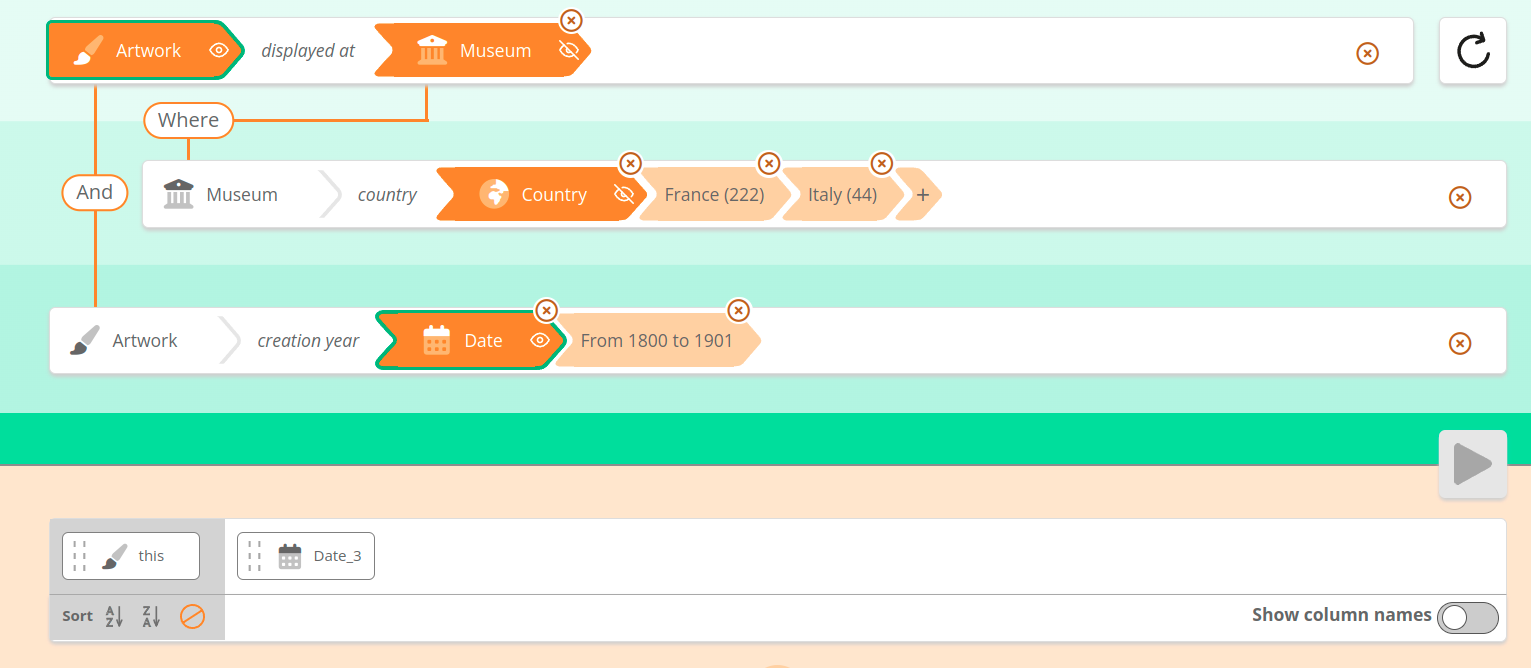
Is encoded in the following JSON data structure :
{
  "distinct": true,
  "variables": [
    {
      "termType": "Variable",
      "value": "Artwork_1"
    },
    {
      "termType": "Variable",
      "value": "Date_6"
    }
  ],
  "order": null,
  "branches": [
    {
      "line": {
        "s": "Artwork_1",
        "p": "https://data.mydomain.com/ontologies/sparnatural-config/Artwork_displayedAt",
        "o": "Museum_2",
        "sType": "https://data.mydomain.com/ontologies/sparnatural-config/Artwork",
        "oType": "https://data.mydomain.com/ontologies/sparnatural-config/Museum",
        "criterias": []
      },
      "children": [
        {
          "line": {
            "s": "Museum_2",
            "p": "https://data.mydomain.com/ontologies/sparnatural-config/Museum_country",
            "o": "Country_4",
            "sType": "https://data.mydomain.com/ontologies/sparnatural-config/Museum",
            "oType": "https://data.mydomain.com/ontologies/sparnatural-config/Country",
            "criterias": [
              {
                "label": "Italy",
                "criteria": {
                  "rdfTerm": {
                    "type": "uri",
                    "value": "http://dbpedia.org/resource/Italy"
                  }
                }
              },
              {
                "label": "France",
                "criteria": {
                  "rdfTerm": {
                    "type": "uri",
                    "value": "http://dbpedia.org/resource/France"
                  }
                }
              }
            ]
          }
        }
      ]
    },
    {
      "line": {
        "s": "Artwork_1",
        "p": "https://data.mydomain.com/ontologies/sparnatural-config/Artwork_creationYear",
        "o": "Date_6",
        "sType": "https://data.mydomain.com/ontologies/sparnatural-config/Artwork",
        "oType": "https://data.mydomain.com/ontologies/sparnatural-config/Date",
        "criterias": [
          {
            "label": "between 1801 and 1900",
            "criteria": {
              "min": 1801,
              "max": 1900
            }
          }
        ]
      }
    }
  ]
}
JSON data structure reference
Basically, the JSON data structure encodes a bit more information than the generated SPARQL query, to make our life easier when parsing the data structure to initialize Sparnatural with it. It adds:
- The labels of the values
- The types of all subjects and objects
- The tree-like structure that Sparnatural uses, which would be hard to guess by looking at the SPARQL string
The data structure is composed of a top “Query” structure, that contains “branches”. Each “branch” contains a “query line”, corresponding to one line of the Sparnatural interface, and the “children” of this line, that are the lines under it in the Sparnatural interface.
Query structure
{
  "distinct": true,
  "variables": [
   {
      "termType": "Variable",
      "value": "this"
    },
    {
      "termType": "Variable",
      "value": "that"
    }
  ],
  "order": null,
  "branches": [
    ...
  ]
}
distinct: whether theDISTINCTSPARQL keyword should be addedvariables: ordered list of variables selected in theWHEREclause.termTypeis alwaysVariable, andvalueis the variable name (without “?”)order: e.g."asc"or"desc"depending on sort direction. Ornullif no sort. The sort is always on the first column.branches: ordered list of query branches, each containing a “tree” of criteria under it
Query branch structure
{
      "line": {
        ...
      },
      "children": [
        ...
      ],
      "optional": true,
      "notExists": false,
    },
line: one single query line / criteriachildren: the children of that line / criteria, the ones that are below it in the Sparnatural query builder. This may not be present at all, or can be an empty array.optional: whether the line and all its children are optional (use a SPARQL “OPTIONAL”)notExists: whether the line and all its children are negative (use a SPARQL “FILTER NOT EXISTS”)
Query line structure
{
  "line": {
    "s": "Museum_2",
    "p": "http://ontologies.sparna.fr/sparnatural-demo-dbpedia#country",
    "o": "Country_4",
    "sType": "http://ontologies.sparna.fr/sparnatural-demo-dbpedia#Museum",
    "oType": "http://ontologies.sparna.fr/sparnatural-demo-dbpedia#Country",
    "criterias": [
        ...
    ]
  },
  "children": []
}
s: variable of the subjectp: URI of the predicateo: variable of the objectsType: URI of the selected type of the subjectoType: URI of the selected type of the objectcriterias: arrays of criterias selected for the object, if any (typically URI of selected values from a dropdown list)
Labelled Criterias
{
  "line": {
    ...
    "criterias": [
        {
          "label": "Italy",
          "criteria": {
            ...
          }
        },
        {
          "label": "France",
          "criteria": {
            ...
          }
        }
    ]
  }
}
A criteria is composed of 2 parts:
label: The display label of the criteriacriteria: The actual criteria to use, depending on the value selection widget (e.g. either a URI, a date range, etc.)
Criteria values
The structure of the criterias depends on the value selection widget. This can be :
- A URI selection widget (dropdown list, autocomplete, tree widget):
If the value is a URI:
{
  "criteria": {
    "rdfTerm": {
      "type": "uri",
      "value": "http://fr.dbpedia.org/resource/Italie"
    }
  }
}
If the value is a Literal (with a language):
{
  "criteria": {
    "rdfTerm": {
      "type": "literal",
      "value": "foo",
      "xml:lang": "en"
    }
  }
}
If the value is a Literal (with a datatype):
{
  "label": "xxx",
  "criteria": {
    "rdfTerm": {
      "type": "literal",
      "value": "1",
      "datatype": "http://www.w3.org/2001/XMLSchema#integer"
    }
  }
}
- A time/date selection widget:
{
  "label": "xxx",
  "criteria": {
    "start": "1800-01-01T00:00:00",
    "stop": "1901-12-31T23:59:59"
  }
}
- A boolean widget:
{
  "label": "xxx",
  "criteria": {
    "boolean": true
  }
}
- A regex search widget:
{
  "label": "xxx",
  "criteria": {
    "search": "..."
  }
}
- A number widget:
{
  "label": "xxx",
  "criteria": {
    "min": 10000,
    "max": 100000
  }
}
- A map widget:
  {
    "label": "xxx",
    "criteria": {
      "coordType": "Rectangle",
      "coordinates": [
        { "lat": "1", "long":"1" }
        { "lat": "2", "long":"2" }
        { "lat": "3", "long":"3" }
        { "lat": "4", "long":"4" }
      ]
    }
  }
Aggregated variables
If the query has aggregated variables (such as COUNT(?x)), the variable query structure changes to the following:
{
  "distinct": true,
  "variables": [
    {
      "expression": {
        "type": "aggregate",
        "aggregation": "count",
        "distinct": false,
        "expression": {
          "termType": "Variable",
          "value": "Artwork_1"
        }
      },
      "variable": {
        "termType": "Variable",
        "value": "Artwork_1_count"
      }
    }
  ]
}